
Susto
Exploring Soul Loss in Latin America

What is Susto?
Susto is a folk illness prevalent in Latin American culture. The name, susto, in the most literal, contextually removed way, means fright. However, when framed as illness, this fright takes on a meaning far beyond something provoked by a simple jump-scare. Let’s look a bit deeper into what it actually is: its causes, symptoms, and cures.
Susto is, at its core, is a loss of self – or as some scholars put it, a loss of soul – caused by an abrupt confrontation with insecurity, instability, and/or harm. Early records indicate that in Central Mexican Nahua culture, susto refers to the loss of tonalli, or solar energy — a vital force linked to the sun that governed health, vitality, and destiny (Castro & Eroza, 1998). Because tonalli was thought to be mobile, it could leave the body through fright or force, sometimes entering a new vessel entirely.
It is believed by some that malignant spiritual energies thrive on stealing tonalli, and that children, due to their easily frightened nature, are especially vulnerable. Think of Monsters, Inc. — the fictional scream-processing plant that generated power through scaring children in their sleep. In the film, the greater the fright, the greater the energy. Traditional thought believes in much the same way: the deeper the fear, the greater the vitality stolen.
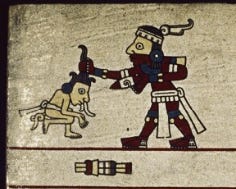
Image: A scene from the Codex Laud depicting a richly adorned figure piercing the crown of a kneeling captive, interpreted by scholars as a ritual extraction of tonalli*. Image courtesy of the Bodleian Libraries, University of Oxford (Public Domain).*
Today, the concept of tonalli has left Nahuatl, and shifted into the Spanish sombra or “shadow.” The original principle remains: if your tonalli has left you, you have lost your shadow. I love the nuance of this idea — the connection of having soul as an integral part of our humanness. For if you stand, solid as you are, without casting a shadow, – without having a soul – then what really are you?
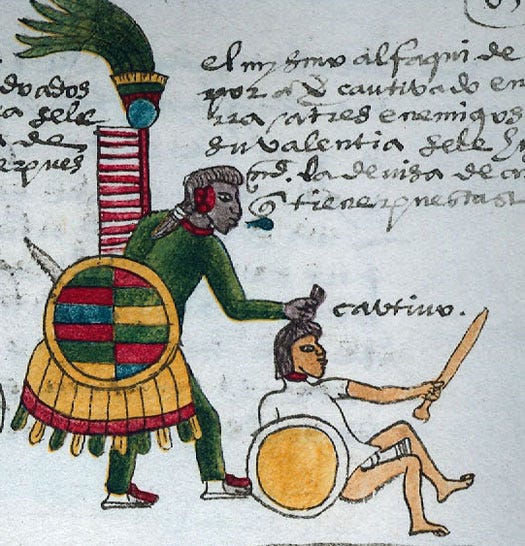
Image: From the Codex Mendoza — a Mexica warrior seizes an enemy by the hair at the crown, symbolically taking their tonalli*. Image courtesy of the Bodleian Libraries, University of Oxford (Public Domain).*
Susto Today
What I’ve just laid out is specific to the central highlands of Mexico, but susto spans thousands of miles, from coastal towns to jungles. Today, it affects women, men, and children alike, regardless of status, religion, or background. Researchers note that susto often follows events that fit three criteria: random, unpredictable, and dangerous — for example, car accidents, robberies, sudden illnesses, assaults, or encounters with wild animals (Castro & Eroza, 1998). In regions marked by instability, poor infrastructure, or systemic violence, the number of opportunities to experience susto increases dramatically.
Susto is seen by many as soul-loss, pre-empted by an abrupt confrontation with insecurity, instability, and/or harm. When a person is confronted with a circumstance – believed to be comfortable, secure, or routine – that turns out to be dangerous or negatively life-altering, the sufferer experiences a profound physiological response ranging from fatigue all the way to death.
How Does Susto Manifest?
“When one doesn’t have the shadow, one feels tired, and that sleepiness of the evening; and the body feels weak. My mother-in-law would say: ‘you don’t have the shadow” as one Ocuituco resident told researchers (Castro & Eroza, 1998).
Physically, when a person is confronted with a circumstance – believed to be comfortable, secure, or routine – that turns out to be dangerous or negatively life-altering, the sufferer experiences a profound physiological response ranging from fatigue all the way to death. Spiritual, they become untethered to themselves to the point that they can’t even find a them to be rebound to.
If tonalli is our vitality, then being without would be exactly that. Imagine, being so devoid of energy, every action taken requires all the resolve you can muster. A death while living. The afflicted begin to lose weight because their appetite has gone with their shadow. Sleep is plagued by bad dreams and the skin below their sunken, hallowed eyes grow darker and darker. If they are able to get out of bed, their joy isn’t with them. They can be easily startled and are never at ease. Though symptoms vary, many believe that if susto is left untreated, it can open the door to serious illness. In some communities, even conditions like diabetes, and subsequent death, have been attributed to susto (Castro & Eroza, 1998).
Una Limpia
“Shadow, come back to your center.”
The most common way to treat a case of lost shadow is by participating in una limpia. Each curandero has their own way, but similarities do exist between practitioners. At its core, a limpia aims to identify what is plaguing the afflicted, expel it from both their spiritual and physical bodies, and replace it with what belongs there — in this case, the person’s soul.
Among those similarities, plants play a central role. Alongside prayers, incantations, and songs, are richly aromatic herbs and flowers. Susto and other mal aires do not fare well when met with fragrant, perfumed air. The healer gathers plants such as peppermint, mint, rue, and rosemary; trees like citron and eucalyptus; and flowers including carnations and feverfew, among others. The selection depends greatly on geographic region and specific belief systems (Cavender & Albán, 2009). Once the herbs are collected and cleaned, they are bundled by the stems to create what some call the escobita (little broom) or ramos benditos — loosely translated as “blessed branches/bouquet/bunch.” Some practitioners first warm the bundle over an equally blessed fire, stems lightly cracking as the scented smoke rises into the air.
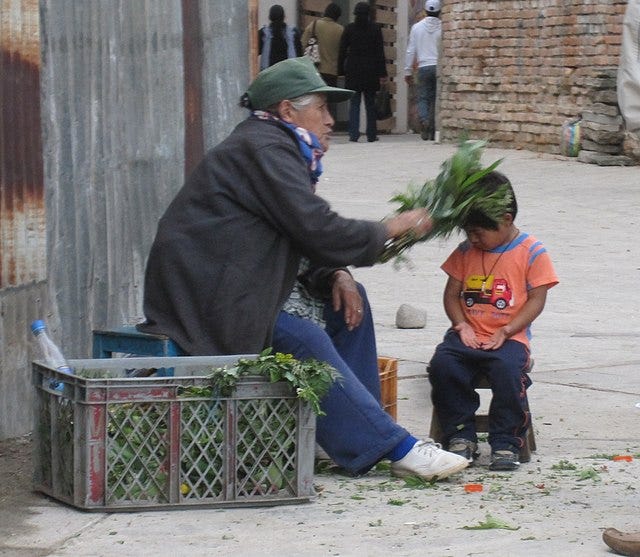
Image: Curandera performing a limpia in Cuenca, Ecuador, using a bundle of aromatic herbs. Photo by calliopejen, licensed under CC BY-SA 2.0 via Wikimedia Commons.
https://commons.wikimedia.org/wiki/File:Curandera_performing_a_limpieza.jpg

In the way that we clean our homes – with the right products and tools – we sweep the floors with the intention of leaving them restored in our wake. First, we remove what doesn’t belong — dirt, pet hair, fallen food — revealing the floor as it is. Then we add a disinfectant, often fragranced, to finalize the process and ensure anything harmful is removed. In the most stripped-back sense, a spiritual limpia works in much the same way. As the name “little broom” suggests, the curandero moves the gathered plants across the body, from head to toe, sweeping away what doesn’t belong. In some traditions, healers sing songs of restoration; some speak incantations of love; others may say these words silently. In the central highlands of Mexico, a curandera might command the shadow to return to its rightful place, repeating this as she works.
Throughout the Ecuadorian Andes, together with the sweeping action, some healers crush and rub the leaves in their hands, releasing the oils and scent of the plant directly onto the skin of the patient. Eucalyptus is often steamed and inhaled, and other herbs might be boiled into decoctions and sprayed over the afflicted (Cavender & Albán, 2009). The method will vary, but the power of smell remains constant. Through whichever method the plants and their essence are brought onto — and effectively into — the patient, the result is the same: loosening the grip that susto has on them.
However many sessions it takes, the patient should begin to feel lighter and more energized, until eventually they feel like themselves again. Their shadow will have returned, and their life feels more like theirs. It really is a wonder to consider, how even in the face of such unpredictability, randomness, and apparent chaos constantly surrounding us, we can still be powerfully tethered to something, even if that something is only ourselves.
Further Reading
Bodleian Library. Codex Laud [Digital Collection]. University of Oxford.
Bodleian Library. Codex Mendoza [Digital Collection]. University of Oxford.
Castro, R., & Eroza, E. (1998). Research Notes on Social Order and Subjectivity: Individuals’ Experience of Susto and Fallen Fontanelle in a Rural Community in Central Mexico. Culture, Medicine and Psychiatry, 22(2), 203–230.
Cavender, A. P., & Albán, M. (2009). The Use of Magical Plants by Curanderos in the Ecuador Highlands. Journal of Ethnobiology and Ethnomedicine, 5(3).